
Charles Brown House
By: Andrew Kramer
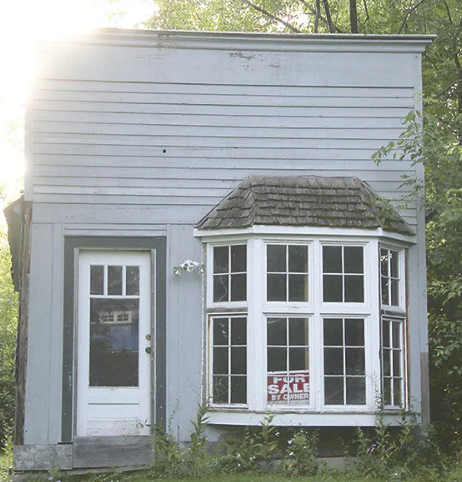
Walking south from the center of Marine on St Croix, you will encounter a small lot at the corner of Judd and Berkey streets and its dilapidated old storefront building with bay windows. A for-sale sign indicates both can be yours for a mere $20,000. Despite that low price, the property has not sold in five years on the market. It’s not for lack of interest. The seller has gotten hundreds of calls. It’s an intriguing story about a building with a significant past and a problematic future.
The low asking price belies the historic value of the storied building on the lot. It was one of the state’s earliest apothecaries and Marine’s first dedicated post office building. Back then it was located in the heart of the village on Maple Street just west of Henry Olsen’s general store on the corner of Parker and Maple streets. Olsen’s store, along with many surrounding 19th century buildings, was lost to demolition when state highway 95 replaced Judd Street as the way through Marine. However the post office building was saved from destruction by its owners.
Former residents Cindy Jepsen and her husband purchased and moved the building to its current location at 400 Judd St, which at the time was also part of their residential property across the street at 401 Judd. They bought it when a developer threatened to destroy the old building. They knew it was worth preserving, because Cindy researched its history with local historian James Dunn.
They determined it may have been built for a granary in the upper village, and then moved to Maple St behind Olsen’s store. There, in the early 1900s, it became a confectionary and apothecary, perhaps the first in the state according to Jepsen. She was told by Bertha and Myrtle Holmstrom that their father and early Marine resident, Fred Holmstrom, was the proprietor. The succeeding owner Swen Magnuson was Marine’s postmaster from 1910 to 1915. He turned it into the first dedicated post office building in Marine Mills, as the town was then known. Prior to this, the post office had always been co-located in business stores. C. A. Ecklund became the new postmaster and was at this post office in 1917 when the postal service changed the town’s address to Marine on St Croix.
When the post office changed location in the late 1920s, the building belonged to a local realtor, Charlie Brown. It became his real estate office into the 1960s. Brown saved the building from the highway 95 demolitions by moving it west to Broadway St., away from the construction. There it remained until the Jepsens acquired it around 1978, moving it to their lot on Judd St and making some restorations. Cindy Jepsen became sole owner of the building in 1990 when the lot at 400 Judd St. was split from the residential property at 401 Judd St. as part of a divorce settlement. As a result of the split, the building now stood on a substandard residential lot.
Cindy Jepsen sold the building and lot in 2010 to current owners, Rollin and Becky Alm, who intended to do a historic restoration of the structure and use it as a private art studio. Rollin is a commercially successful fine art painter, who was living in May Township and wanted a new studio, which he could not build on his residential property. So instead he bought the building and lot from Jepsen, which was advertised as being “ideal as an artist’s studio or artisan’s workshop.” They bought the property “as-is” for $64,500 with an inheritance from Becky’s father. They admit in retrospect, they should have checked the local building codes before purchase, because as Rollin started to stabilize the structure, he was stopped by the City of Marine. He was told the City needed to determine whether a studio would be permitted on the substandard lot. It was less than the required 1 acre minimum and adjacent to a wetland.
The issue went before the Planning Commission three times between 2010 and 2011, where the Alms and their attorney argued the building should be permitted for an accessory use, and proposed installing a septic holding tank that would be safe for the nearby wetland. At a final meeting in April 2012, the Commission disagreed, citing codes that an accessory structure is permitted only on lots that also have a dwelling, which was eliminated by the property split in 1990. The Alms formally applied for variances at the May 2012 City Council meeting. Based on the Planning Commission recommendation, the Council denied their application.
No one is happy with the decision. Dan Willenbring, who was on the Planning Commission then, said they really tried but were unable to find any allowable use for the building on that lot. “It’s a very sad thing,” said Rollin. “We have to relive the disappointment every time we go back there.” When they moved here, the Alms were attracted to Marine because of its rural, nostalgic character. However after these events, the Alms felt rejected by Marine and moved out of town. They now live in Somerset Wisconsin, where Rollin has built a large studio.
Since putting the property up for sale, the Alms have diligently told prospective buyers to contact the City first, after which they never hear back from them. The attorney for the Alms said one of their options is to sue the City of Marine for “regulatory taking of your property” or sue the seller for false representation. They have no intention to do either. Instead, Becky said , “We continue to mow the lawn, pay the taxes and hope the building doesn’t fall down before somebody finds a good use for it.” When asked what they would do with the property, Rollin replied they will neglect the building but hold onto the land, which he believes may eventually have value.
“I feel bad about the disrepair it’s fallen into,” said Cindy Jepsen about the old building. According to Rollin, it needs immediate structural support. He saved much of the original wood and flooring and was planning to restore the building with historic construction methods, including mortise and tenon joints, post and beam supports, and rough sawn lumber. He had planned to spend $30,000 to $40,000 on the restoration. He estimates it would cost about $20,000 in materials to stabilize the building now.
When asked about the building’s fate, Planning Commissioner Jack Warren noted that Marine is a registered National Historic District, which means preservation of the historical streetscape is beneficial to the City. He thinks restoring a building of that period can add to the streetscape. Warren thought there wouldn’t be any prohibition against restoring the building where it is, just its use. Zoning administrator, Lynnette Peterson agreed, but added that some repairs might require a building permit from the City and would need to include limitations on use. Warren surmised, even the building’s use might be resolved if it became part of an adjoining lot with a dwelling.
Another option is to move the building. “I would like to see it moved,” said Warren, suggesting that it would fit well in Burris Park next to the log cabin, which is an example of Swedish immigrant construction methods before mechanization. By comparison, Warren observed, the old post office building “is representative of the construction practices of a town that had a sawmill.” Both have community ties, according to Warren: “The log cabin was used by farmers that supplied food to Marine before it was shipped in, and the other had a commercial use.”
One possible future is clear. Without some community interest, the building will self-destruct. It would be an ignoble end to such a rare and relevant piece of local Marine history.